
Blog
From Legacy Core Banking to a Future-Ready Platform: Nimble Transformation Journey
Building a Modern, Scalable and Future-Ready Banking Foundation
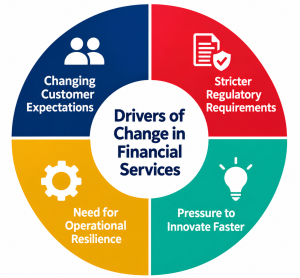
The financial services industry is undergoing a fundamental transformation. Customer expectations are changing, regulatory requirements are becoming more demanding, and financial institutions are under increasing pressure to innovate faster while maintaining operational resilience.
At the heart of this transformation is the core banking platform.
For one financial institution in Sri Lanka, the limitations of its legacy core banking environment had increasingly become a constraint on business agility, product innovation and long-term technology sustainability. The institution therefore embarked on a transformation journey to establish a modern, scalable and sustainable core banking foundation with Nimble Core Banking.
This was not simply a technology replacement exercise. It was a broader business transformation initiative aimed at strengthening operational resilience, improving efficiency, enabling faster product innovation and creating technology foundation capable of supporting the institution’s long-term growth strategy.
The Business Challenge: When Legacy Technology Becomes a Constraint
The institution’s existing core banking platform had supported its operations for many years. However, as the business evolved, several challenges became increasingly apparent.
Reducing Vendor Dependency
The organization had significant dependency on a single vendor for system support, maintenance and enhancements. This created challenges in responding to change and limited the organization’s ability to influence the pace at which the platform could evolve.
Strengthening Business Continuity and Sustainability
Concerns around business continuity, source-code availability and the long-term sustainability of the legacy platform highlighted the need for greater technology resilience and control.
Accelerating Product Innovation
Introducing new products and implementing system enhancements could be time-consuming. In an increasingly competitive financial services environment, this can directly affect an institution’s ability to respond to changing customer and market requirements.
Managing Rising Maintenance Complexity
As technology ages, maintaining legacy platforms and introducing new capabilities can become increasingly complex and resource intensive.
Improving Business Agility
The existing environment offered limited flexibility to respond rapidly to changing business, operational and regulatory requirements.
Together, these challenges created a clear strategic imperative: move from a constrained legacy environment to a modern core banking platform capable of supporting continuous change.
The Transformation Imperative
The institution defined a number of strategic priorities for the transformation:
- Reduce vendor dependency and business continuity risks
- Establish a modern and scalable core banking platform
- Improve operational efficiency through automation
- Enable faster product development and configuration
- Strengthen governance, security and regulatory readiness
- Create a technology foundation for future digital transformation
The objective was therefore not simply to replace an existing system, but to create a platform capable of supporting the institution’s future business direction.
The Transformation Journey
A successful core banking transformation requires more than selecting a new platform. It requires a structured approach that considers business processes, technology, data, people, integrations and organizational change. The transformation journey followed a structured approach.
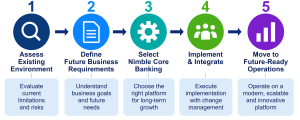
1. Assessing the Existing Environment
The journey began with an assessment of the existing technology and operating environment. The institution evaluated technology limitations, operational challenges, vendor dependencies and business continuity considerations. This provided a clear understanding of the risks and constraints that needed to be addressed.
2. Defining Future Business Requirements
The next step was to understand where the institution wanted to go. Future business requirements, products, services, integrations, regulatory needs and digital initiatives were considered in defining the capabilities required from the new core banking platform. This helped ensure that the transformation was aligned with business strategy rather than being driven purely by technology.
3.Selecting Nimble Core Banking
Following the evaluation process, the institution selected Craft Silicon’s Nimble Core Banking System (CBS) as the foundation for its next-generation banking environment. Nimble provides a modern core banking platform designed to support scalability, integration, automation, product configuration and evolving business requirements.
For APTS, the objective was to support the institution not only through implementation, but through a structured transformation journey focused on business continuity, operational readiness and long-term value.
4. A Structured Implementation Approach
The transformation incorporated multiple dimensions of implementation, including:
- Business process redesign
- Core banking configuration
- Data migration
- System integration
- Testing and validation
- User training
- Change management
- Governance and project controls
A phased approach provides an important mechanism for managing implementation risk while
maintaining business continuity.
5. Governance, Testing and Change Management
Technology transformation is ultimately a people-and-process journey as much as it is a technology journey.
Strong governance and testing processes were therefore established to ensure that the new environment aligned with business and operational requirements.
User training and change management were also integral to helping employees transition to
new processes, workflows and capabilities.
How Nimble Enables the Transformation
The adoption of Nimble provides the institution with a centralized and scalable core banking platform designed to support evolving business requirements.
A Scalable Core Banking Foundation
Nimble provides a centralized platform for core banking operations, creating a stronger technology foundation for future growth.
Its scalable architecture is designed to support changing business volumes, products, services
and customer requirements.
Greater Flexibility Beyond Legacy Constraints
Moving away from a legacy environment can reduce dependency on outdated technologies and platform-specific constraints, providing greater flexibility to respond to future business and technology requirements.
Faster Product and Service Enablement
A modern core banking platform can help financial institutions respond more effectively to market requirements by simplifying the introduction and configuration of products, services and regulatory changes.
This creates the potential to improve time-to-market and support more agile product development.
Improved Integration and Information
Modern core banking environments need to operate as part of a broader digital ecosystem. Improved integration and reporting capabilities enable stronger connectivity between core banking operations and other enterprise and digital platforms, while better access to operational information can support management decision-making and control.
Automation and Workflow Digitization
Automation and workflow-based processes can reduce manual intervention, improve
consistency and streamline day-to-day operations. This creates opportunities to improve both operational efficiency and process control.
Enabling Better Customer Service
The impact of core banking modernization ultimately extends beyond technology.
More efficient operational processes and the ability to introduce products and services more efficiently can help financial institutions respond more effectively to changing customer expectations.
The Business Impact
The transformation is expected to create benefits across technology, operations, risk management and customer service.
These include:
Operational resilience
A modern core banking platform provides a stronger foundation for business continuity and operational resilience.
Reduced technology and vendor risk
Moving away from legacy technology can help reduce technology-related constraints and dependency risks.
Faster time-to-market
Greater platform flexibility can support faster introduction of products, services and changes. Improved management information
Better reporting and access to operational information can support more informed management decision-making.
Enhanced customer experience
More efficient processes and greater business agility can contribute to improved customer service.
Improved scalability
The new platform establishes a foundation that can evolve alongside the institution’s future business requirements.
Lower long-term technology complexity
Replacing aging technology creates the potential to reduce the complexity associated with maintaining and enhancing legacy platforms.
Beyond Core Banking: Creating a Platform for Digital Transformation
A core banking transformation should not be viewed as the end of a technology journey. It should be viewed as an enabler for the next stage of business transformation.
With a modern core banking platform in place, the institution can build on this foundation to explore further digital services, automate additional processes, integrate with emerging technologies and respond more effectively to changing customer and regulatory expectations.
The transformation also creates an opportunity for continuous improvement — allowing business processes to evolve rather than being constrained by the limitations of legacy technology.
Looking Ahead
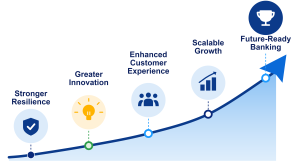
The financial services landscape will continue to evolve. Customer expectations, regulatory requirements, competition and emerging technologies will continue to reshape how financial institutions operate.
In this environment, technology agility is becoming increasingly important.
By transitioning from a legacy environment to Nimble Core Banking, the institution is establishing a more flexible, scalable and sustainable technology foundation — one designed to support operational resilience, product innovation, automation, improved customer service and future digital initiatives.
From Core Banking Transformation to Business Transformation
The real value of a core banking transformation extends beyond the technology itself. It is about enabling the organization to operate more efficiently, respond faster to market
opportunities, manage risk more effectively and create better experiences for customers.
Through the adoption of Nimble, the institution is building a modern core banking foundation designed to support today’s operational requirements while preparing the organization for future growth and digital transformation.
At APTS, we believe core banking transformation is not simply about replacing a system. It is about creating the technology foundation that enables financial institutions to transform their business.
Nimble – enabling financial institutions to build a more agile, scalable and future-ready banking ecosystem.
Email: info@apts.lk
Contact Us: 0112 375 656
Article Written By- Asela Seneviratne (Chief Delivery Officer)
 +94 112 375 656
 info@apts.lk
 422/3,Galle Road, Colombo 3, Sri Lanka