
Blog
Beyond IPv4: Understanding the Importance of IPv6 for Future Networking
Introduction
As the Internet continues to expand rapidly and the demand for IP addresses has increased significantly. IPv6 is the most recent version of Internet Protocol (IP). The traditional IPv4 protocol, which has been the backbone of internet communication, is now facing a serious limitation due to the depletion of its address space. To address this issue, IPv6 (Internet Protocol version 6) was developed as the next-generation IP protocol. This article explores the importance of IPv6, its benefits, challenges, and the future of networking in an IPv6-dominated world.
The Critical Need for IPv6: Overcoming IPv4 Address Exhaustion
IPv4, which uses a 32-bit address system, can support approximately 4.3 billion unique IP addresses. With the rise of mobile devices, IoT (Internet of Things), and increasing internet adoption worldwide, this number is no longer sufficient. IPv6, with its 128-bit address system, offers a practically unlimited number of IP addresses, ensuring continued growth and expansion of the internet.
The transition to IPv6 is a global effort backed by governments and networking organizations. Many governments are promoting and mandating IPv6 adoption, while leading internet providers and major websites have already made the switch. To stay aligned with global standards, enterprises must also transition to IPv6.
Understanding IPv6 Addresses: A Look at the 128-bit System
Unlike IPv4, which uses dot-decimal notation (ex: 192.168.1.1), IPv6 addresses are represented in hexadecimal format with each hex digit representing 4 bits., separated by colons (ex: 2001:0db8:85a3:0000:0000:8a2e:0370:7334).
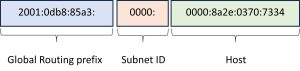
Some key characteristics of IPv6 addressing include:
- Larger Address Space: 128-bit addresses can accommodate an immense number of unique IPs.
- Auto-configuration: IPv6 supports stateless and stateful address configuration, reducing administrative overhead.
- Simplified Header Format: Streamlines packet processing, improving network efficiency.
- No Need for NAT (Network Address Translation): Direct communication between devices is possible, improving security and performance.
Key Benefits of IPv6: Enhanced Security and Network Efficiency
- Scalability: IPv6 eliminates the address exhaustion problem, ensuring enough IP addresses for future expansion.
- Improved Security: IPv6 integrates IPsec (Internet Protocol Security) for encryption and authentication, enhancing network security.
- Better Performance: The elimination of NAT results in reduced latency and improved network efficiency.
- Enhanced Mobility and IoT Support: IPv6 simplifies device connectivity in a world dominated by smart devices and IoT networks.
Overcoming the Challenges of Transitioning to IPv6
Migrating from IPv4 to IPv6 presents several challenges that organizations must address to ensure a smooth transition.
- Lack of Backward Compatibility – IPv4 and IPv6 are not directly interoperable, requiring complex transition mechanisms such as dual-stack, tunneling, and translation, which add to network complexity.
- Infrastructure Upgrade Costs – Many legacy networking devices and applications do not support IPv6, necessitating costly hardware and software upgrades.
- Skill Gap and Training Needs – IT teams need additional training to manage IPv6 networks, as its configuration and troubleshooting differ from IPv4.
- Security Considerations – While IPv6 has built-in security features like IPsec, new attack vectors and misconfigurations can introduce vulnerabilities during migration.
- Application and Service Compatibility – Many applications and services are designed for IPv4 and may not function correctly on IPv6 without modifications or updates.
- Transition Complexity – Organizations must plan a phased transition strategy to avoid downtime and ensure service continuity while gradually adopting IPv6.
Addressing the Challenges of IPv6 Migration
While IPv6 migration presents challenges, there are several strategies to mitigate these issues and ensure a smooth transition.
- Upgrading Infrastructure Gradually: Organizations can implement a phased migration strategy, replacing legacy IPv4 devices with IPv6-compatible hardware over time to spread costs and reduce disruption.
- Using Transition Mechanisms: Techniques such as dual-stack implementation, tunneling, and translation (e.g., NAT64) help facilitate communication between IPv4 and IPv6 networks, allowing a smoother coexistence period.
- Dual-Stack Implementation: This method allows devices to support both IPv4 and IPv6 simultaneously, enabling a gradual transition. Devices and applications can communicate using either protocol as needed, reducing compatibility issues.
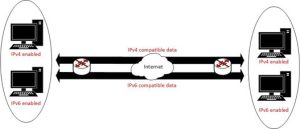
- Tunneling: Tunneling encapsulates IPv6 packets within IPv4 packets, allowing them to travel across an IPv4 network. This is useful when two IPv6-enabled devices need to communicate over an IPv4-only infrastructure.
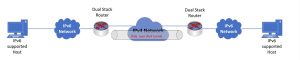 Translation (NAT64): NAT64 enables IPv6-only clients to communicate with IPv4 servers by translating IPv6 addresses into IPv4 addresses. This is crucial for transitioning networks where legacy systems still operate on IPv4.
- Investing in Training and Network Management Tools: Businesses should invest in training IT personnel and deploying modern network management tools designed for IPv6 to simplify configuration, monitoring, and troubleshooting.
- Driving IPv6 Adoption: Government and Enterprise Initiatives: Governments and enterprises can promote IPv6 adoption through incentives, regulations, and awareness programs to accelerate global transition and interoperability.
The Inevitable Shift to IPv6: What’s Next for Your Organization?
IPv6 is not just an upgrade; it is a necessity for the future of the internet. Its ability to handle the growing number of connected devices, improve security, and enhance network efficiency makes it an essential protocol for modern networking. While challenges remain in its adoption, the shift towards IPv6 is inevitable, and organizations must prepare for a world where IPv6 is the dominant networking standard.
With the increasing adoption of IPv6, especially in regions where IPv4 addresses are scarce, its importance will continue to grow. Governments and major technology companies are pushing for IPv6 implementation, ensuring a smooth transition. As more network devices and services become IPv6-ready, businesses and organizations will need to embrace this new standard to stay competitive.
Take action now by starting with your local office—implementing IPv6 today will position your organization for the future, ensuring you’re ahead of the curve as the world moves toward this essential standard.
 +94 112 375 656
 info@apts.lk
 422/3,Galle Road, Colombo 3, Sri Lanka