
Blog
Identity Governance: Building Access Controls That Stand Up to Audit
Managing privileged and machine identities is becoming increasingly important for organizations that need stronger access governance. Access control is no longer just about deciding whether someone can log in. For regulated organizations, the harder questions are: Should this person have access? Who approved it? Does that access still make sense? And can the organization prove it?
That’s where Identity Governance and Administration (IGA) comes in.
IGA turns access control into a governed process by defining who should have access, enforcing approval and segregation-of-duties rules, managing access throughout the user lifecycle, and producing the evidence needed for audits.
This article looks at why IGA and Privileged Access Management (PAM) have become important parts of access governance, and what a program that actually holds up to audit looks like in practice.
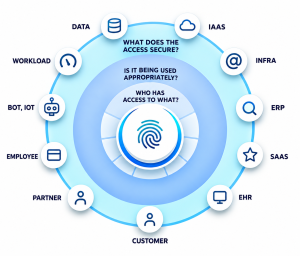
Why Auditors Keep Finding the Same Problem
Look behind almost any major compliance finding, whether it’s ISO 27001, PCI DSS or Sri Lanka’s Personal Data Protection Act, and the root cause is usually the same: someone had access they shouldn’t have had.
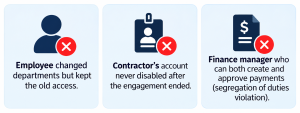
- An employee who changed departments but kept the old access.
- A contractor’s account never disabled after the engagement ended.
- A finance manager who can both create and approve payments, a classic segregation of duties violation
These aren’t exotic hacking scenarios; they’re basic access governance failures. The numbers also show why access controls matter. Verizon’s 2025 Data Breach Investigations Report found that credential abuse accounted for 22% of breaches reviewed, making it one of the leading initial access vectors.
In GRC terms, this is a governance failure long before it’s a technology one.
From Access Control to Access Governance
Identity and Access Management, or IAM, answers a simple question: can this person log in? Identity Governance and Administration, or IGA, answers a harder one: should this person have this access, and can we prove it?
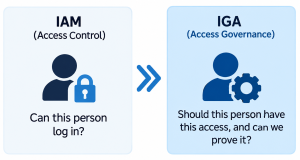
That distinction turns access into a compliance function rather than an IT one, built on three pillars: defining the rules of access, enforcing them at scale, and proving they were followed.
- Defining the rules: Role-based access models and segregation-of-duties enforcement flag toxic combinations, like one person who can both create a vendor and approve payments to them, before they turn into fraud.
- Enforcing at scale: Joiner-mover-leaver automation keeps access in step with HR events instead of lagging weeks behind a ticket.
- Proving control: Audit-ready evidence, a record of who approved what, when, and why, replaces the manual scramble most teams do before an audit.
This enables organizations to maintain audit-ready evidence as part of their ongoing access governance process.
PAM: Enforcing What Governance Decides
Not all access carries equal risk, and governance alone doesn’t control what happens once privileged access is granted. That’s the job of Privileged Access Management, or PAM. If IGA decides who should have access and for how long, PAM controls how that access is used, through:
- Just-in-time privilege, so admin rights exist only for the task at hand.
- Credential vaulting, so passwords and keys are rotated rather than shared.
- Session monitoring, creating a record auditors can actually review.
The two depend on each other. Without PAM, governance stops at the request stage. Without IGA, PAM protects accounts nobody ever reviews.
The September 2025 cybersecurity incident at lending platform Prosper Marketplace illustrates why visibility into privileged and sensitive access matters. Prosper reported unauthorized activity and said that personal information was obtained through queries on company databases between June and August 2025.
Why Annual Access Reviews No Longer Work
None of this works if it only happens once a year. Many organizations still treat access recertification as a spreadsheet exercise, satisfying the letter of a checklist while failing its spirit, and a year is enough time for access to drift out of line with the job it’s meant to support.
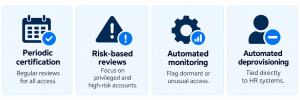
For higher-risk access, organizations can combine periodic certification with event-driven and risk-based controls: risk-based reviews for privileged accounts, automated flags on dormant or unusual access, and deprovisioning tied directly to HR systems.
The Overlooked Risk: Machine and AI Identities
None of it works either if it only covers people. Service accounts, API keys, bots, and now autonomous AI agents often hold standing, high-level privileges, yet sit outside both certification and privileged access processes.
CyberArk’s 2025 Identity Security Landscape report found that machine identities now outnumber human identities by 82 to 1, while 42% of machine identities have privileged or sensitive access.
The governance questions are the same: who owns the identity, what can it access, why does it need that access, and how is that access reviewed?
How to Build an Identity Governance Program
A program that takes this seriously does a few things well: centralizes identity visibility across on premises, cloud, and SaaS systems, automates lifecycle events instead of handling them on request, enforces least privilege by default, layers PAM over the highest-risk accounts, and extends governance to machine identities.
Done right, audit evidence becomes a byproduct of how the system runs, not something assembled under deadline.
Conclusion
The old compliance model assumed you could draw a line around the network and control what crossed it. That model is no longer sufficient. What’s left is the need to govern access wherever it occurs, and every access decision is now, functionally, a governance decision.
Organizations that govern access well, covering humans and machines alike, can demonstrate not only who has access, but why they have it, who approved it, and whether it remains appropriate.
If you’re not sure how exposed your organization is, an identity and access review is the fastest way to find out.
Email: info@apts.lk
Contact Us: 0112 375 656
Article Written By- Menuki Koralage (Intern-Cyber Security)
 +94 112 375 656
 info@apts.lk
 422/3,Galle Road, Colombo 3, Sri Lanka