
Blog
THE INTERNET DOESN’T LIVE IN THE CLOUD. IT RUNS UNDER THE OCEAN.
How submarine cables, networks, and routing connect the world — and what really happens when you access the internet
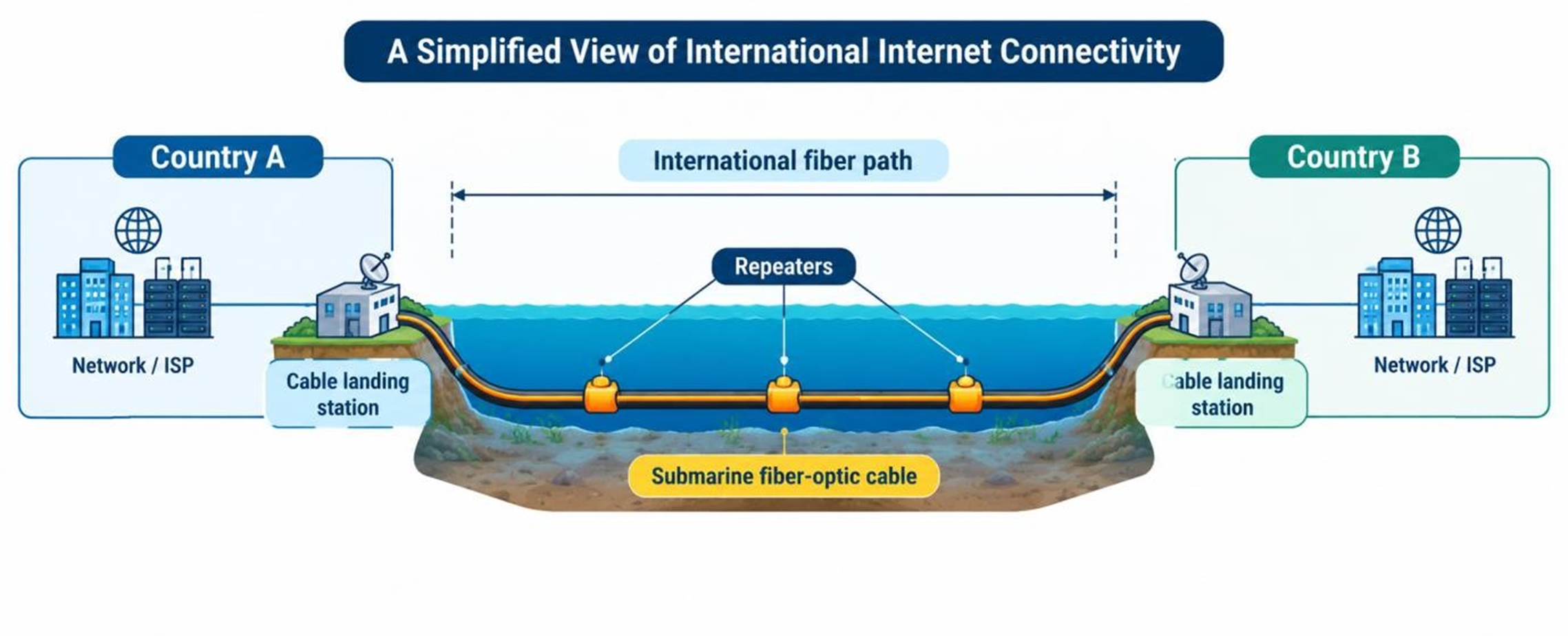
The Internet Has a Physical Side
We often talk about “the cloud” as though our data simply disappears into an invisible digital space.
The reality is very different.
Data needs physical infrastructure to move.
That infrastructure includes data centers, fiber-optic networks, Internet Service Providers, routers and switches, mobile and wireless networks, Internet exchange points, and submarine fiber-optic cables.
The internet is essentially a network of networks, connected together using physical and logical infrastructure across countries and continents.
And when communication needs to cross an ocean, submarine cables are often the path that makes it possible.
What Is a Submarine Cable?
A submarine communications cable is a fiber-optic cable installed on or beneath the seabed to connect countries and continents.
Inside the cable are optical fibers. Instead of sending data as electrical signals over copper for long-distance communication, modern submarine systems use light travelling through optical fiber.
That light carries enormous amounts of information.
Submarine cable systems support web browsing, cloud applications, video streaming, online banking, voice and video calls, business communications, data-center connectivity, and international enterprise networks.
So What Happens When You Open a Website?
Open a browser and enter a website address. It looks like one action, but several network processes take place.
Your device connects to the local network. DNS helps translate the domain name into an IP address. Your device then sends traffic toward its default gateway, and routers forward the traffic toward the destination network.
A simplified path is shown below.
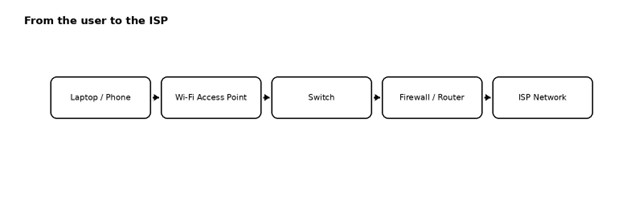
Figure 1 — Simplified path from a user device to the ISP
The Journey Under the Ocean
When a user in one country accesses a service hosted in another, traffic may travel through an international gateway and across one or more submarine cable systems.
The physical route can be much more complex than the simplified diagram, and the exact path depends on network topology, routing policy, connectivity providers, and the location of the destination.
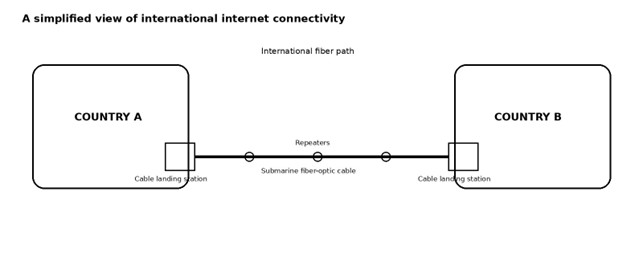
Figure 2 — Simplified international submarine cable connection
Why Fiber Optics?
Fiber is fundamental to modern long-distance networking because it provides high bandwidth and is well suited to carrying large volumes of data over long distances.
Optical fiber carries information using light. This is why fiber is extensively used throughout modern telecommunications infrastructure — from enterprise networks and data centers to international submarine cable systems.
How Does a Submarine Cable Survive Underwater?
Submarine cables are engineered for the environment in which they operate. Near shorelines, cables can require additional protection because of activities such as fishing, anchoring, and seabed conditions.
In deeper waters, the cable can be laid along the seabed. The cable contains protective layers around the optical fibers, designed according to the installation environment and required level of protection.
What Are Repeaters?
Light travelling through optical fiber experiences loss over distance. Long-distance submarine systems therefore use optical repeaters at intervals along the cable route.
These systems help maintain the optical signal over very long distances, allowing the communication system to operate across thousands of kilometers.
One Cable Is Not Enough
A resilient international network cannot depend on a single physical path.
Multiple cable systems and diverse routes can provide alternative connectivity. If one path becomes unavailable, traffic may be rerouted through another available path, depending on network architecture and capacity.
The physical infrastructure provides the paths. Routing determines how traffic uses those paths.
Routing: The Intelligence Behind the Infrastructure
A submarine cable provides a physical path between locations, but networks still need to determine where packets should go.
At the global internet level, BGP — Border Gateway Protocol — plays a major role in exchanging reachability information between autonomous systems.
A simplified concept is:
Physical infrastructure → Network links → Routing information → Best available path → Packet forwarding
Physical Network vs. Logical Network
The internet has both a physical side and a logical side.
The physical layer includes fiber-optic cables, submarine cables, data centers, routers, switches, wireless infrastructure, and cable landing stations.
The logical layer includes IP addressing, routing, DNS, BGP, TCP/IP, network policies, and security controls.
The physical infrastructure provides connectivity. The logical infrastructure determines how that connectivity is used.
What Happens When a Cable Is Damaged?
Submarine cables are highly engineered, but they can still be damaged.
When a cable becomes unavailable, network operators can use alternative routes where capacity and routing
policies allow. The effect on users depends on the affected cable, the location of the fault, available alternative routes, network capacity, routing policies, and traffic engineering.
This is why network resilience is not simply about having a fast connection. It is about having alternative paths when something goes wrong.
Why This Matters to Businesses
International connectivity is now part of everyday business operations. Cloud applications, SaaS platforms, international branches, remote users, data centers, and online services all depend on reliable connectivity.
A business may never own a submarine cable, but its network performance can still depend on them.
This makes international connectivity an important consideration when designing enterprise WANs, internet connectivity, data-center networks, cloud connectivity, SD-WAN solutions, disaster recovery, business continuity, and redundant network paths.
The Journey of a Single Request
Imagine you click a video on your laptop.
Inside the office, traffic may move through Wi-Fi, an access point, a switch, and a gateway or firewall.
Across the internet, it may travel through the enterprise network, ISP, internet backbone, international gateway, submarine cable, and remote network.
At the destination, traffic may reach a data center, load balancer or firewall, application infrastructure, and finally the application.
The response then travels back toward the user.
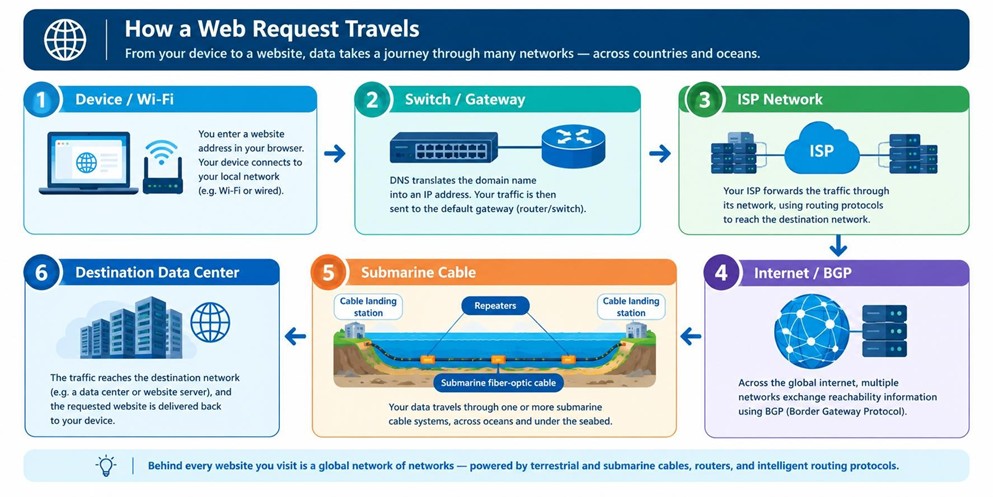
Figure 3 — Simplified end-to-end journey of a web request.
Bigger Picture
The internet is often described as something virtual. But the internet is physical, engineered, interconnected, and continuously managed.
Behind every cloud application is infrastructure. Behind every international connection is a network. Behind every network are physical links. And behind a significant amount of international connectivity are cables crossing the world’s oceans.
That is the part of the internet we rarely see.
The Shift in One Line
“The internet may feel wireless and invisible, but behind every connection is a physical network carrying information across cities, countries, and oceans.”
The Road Ahead: More Data, More Infrastructure
The amount of data moving across global networks continues to grow. Cloud computing, artificial intelligence, video services, connected devices, remote work, digital businesses, and increasingly data-intensive applications all require more connectivity.
This creates continued demand for more submarine cable capacity, diverse international routes, additional data centers, smarter networks, stronger enterprise connectivity, and better visibility across the infrastructure.
THE BOTTOM LINE
The internet is an infrastructure.
The next time you open a website, join a video call, stream a movie, or access a cloud application, remember that your data is not simply travelling through “the cloud.”
It is travelling through a carefully engineered ecosystem of:
Wi-Fi → Switching → Routing → ISP Networks → Internet Backbones → Submarine Cables → Data Centers Every component has a role.
The access point connects you. The switch connects the local network. The router finds the path. The ISP provides connectivity. The submarine cable connects continents. The data center delivers the service. And routing protocols help the global network determine how traffic reaches its destination.
The internet may feel instant.
But behind that instant is one of the largest and most complex engineering systems ever built.
The internet isn’t floating above us.
Much of it is running beneath us.
Email: info@apts.lk
Contact Us: 0112 375 656
Article Written By- Thameera Nadika (Associate Engineer-Network)
 +94 112 375 656
 info@apts.lk
 422/3,Galle Road, Colombo 3, Sri Lanka