
Blog
The Network Wasn’t Built for This.SD-WAN Is How We Fix It.
How SD-WAN rewired WAN architecture — and where it goes from here.
Picture a regional branch office on a Monday morning: someone’s on a video call, another team is pulling live numbers from a cloud ERP, and background systems are quietly syncing to headquarters. Three completely different destinations, three completely different performance needs — all fighting for the same fixed internet pipe. Ten years ago, that branch needed one thing from its network: a stable path back to the data center. Today it needs a dozen things at once, and traditional WAN architecture was never built to juggle them.
The Hidden Tax of “Good Enough” Connectivity
Here’s the thing — nobody schedules a meeting to discuss “our WAN architecture is outdated.” Instead, it shows up as a string of small, disconnected complaints that never quite get traced back to the real cause:
- Cloud apps that feel sluggish, even on “working” internet links
- A single ISP outage that takes down an entire branch
- Expensive MPLS circuits carrying traffic that doesn’t need that level of guarantee
- IT teams with almost no visibility into why an application is underperforming
Notice what’s missing from that list: an actual outage. Nothing “went down.” The links were technically up the entire time — just quietly, invisibly underperforming. That’s the trap. None of these are hardware failures. They’re architecture failures, and architecture failures don’t show up on a status page. They show up in lost productivity, frustrated users, and a help desk that can never quite pin down “why is it slow today.”
What SD-WAN Actually Changes
SD-WAN doesn’t add another link. It adds intelligence to the links you already have. Instead of routing everything down one fixed, static path, it continuously measures every available connection — fiber, broadband, MPLS, LTE/5G — against real conditions, then makes a decision per application, per session, in real time.
- Voice & video: routed over the connection with the lowest jitter, automatically.
- Business-critical apps: kept on the secure, high-availability path to the data center.
- SaaS & cloud: broken out locally, straight to the internet — no backhaul.
This is the shift from “the network is up or down” to “the network is always making the best decision available.” Go back to that Monday-morning branch: the video call gets the quiet connection, the ERP dashboard gets the fast one, and the background sync gets whatever’s left over — without anyone lifting a finger.
How SD-WAN Has Rewritten WAN Architecture
This isn’t a feature upgrade bolted onto the old model — it’s a different starting design. The table below lines up how the fundamentals have shifted, dimension by dimension.
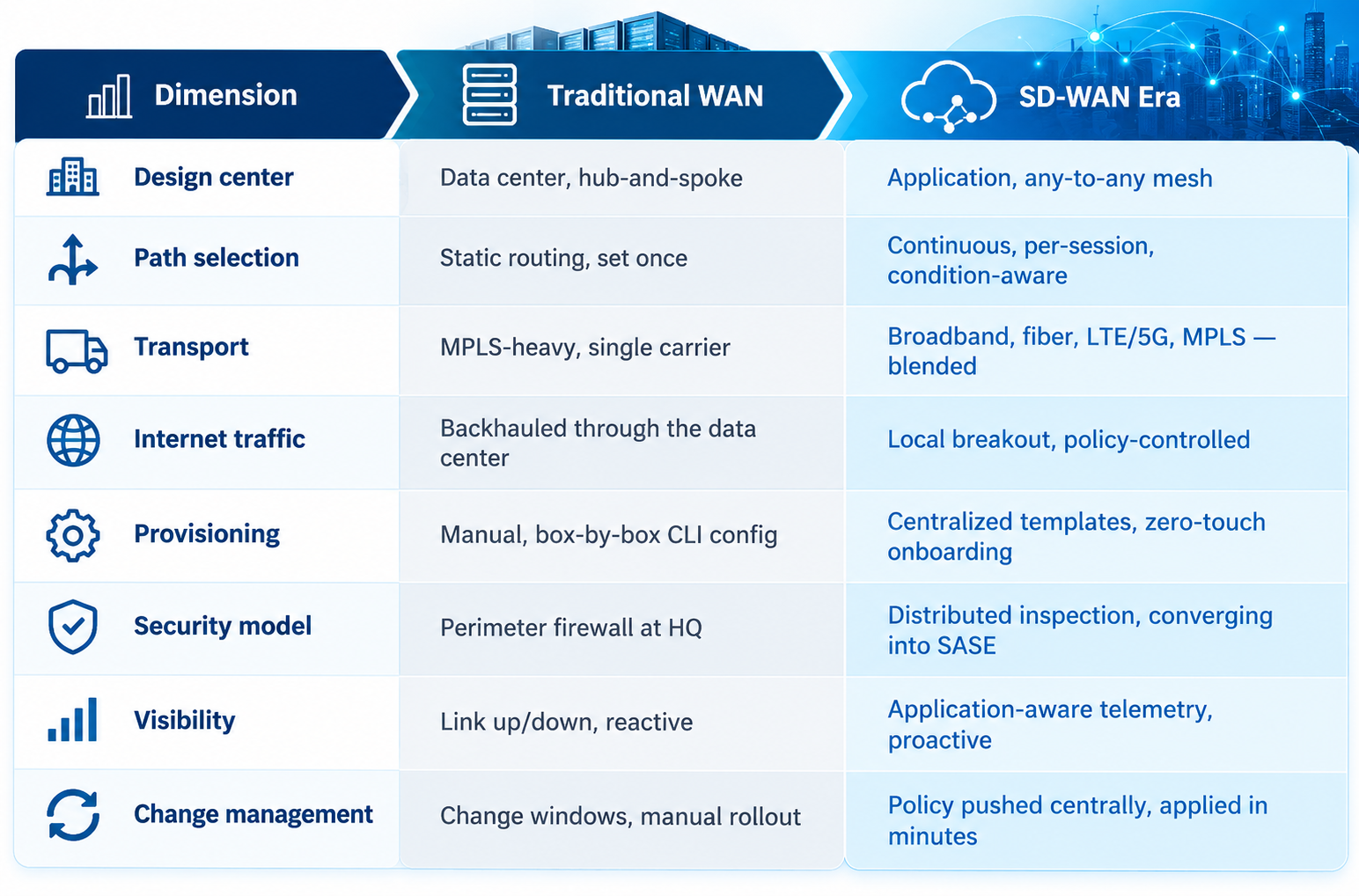 A few of these shifts are worth calling out on their own:
From hub-and-spoke to any-to-any mesh
Classic WAN design routed everything through a central hub, even traffic between two branches sitting a few kilometers apart. SD-WAN’s overlay model lets sites build direct, encrypted tunnels to each other when it makes sense — cutting out a detour that never needed to exist.
From carrier lock-in to transport independence
MPLS used to be the only way to get predictable performance. SD-WAN decouples the application from the underlying transport, so broadband and LTE can carry traffic that once required an expensive private circuit — while MPLS is kept for the sessions that genuinely justify it.
From manual rollouts to centralized orchestration
Provisioning forty branches used to mean forty sets of CLI commands, forty maintenance windows, forty chances for a typo. Templated, centrally-pushed policy and zero-touch provisioning collapse that into one design, applied everywhere at once.
Why This Matters Beyond IT
- Performance becomes predictable — applications route based on real, measured conditions, not hope.
- Resilience becomes automatic — losing an ISP no longer means losing the branch.
- Cost structure improves — MPLS is reserved for what truly needs it; broadband and fiber absorb the rest.
- Deployment gets faster — centralized templates and zero-touch provisioning get new sites live on day one.
- Visibility stops being a guessing game — path selection, performance, and failures live in a single pane.
| THE SHIFT IN ONE LINE
“SD-WAN turns the WAN from a fixed pipe you hope holds up, into a system that actively decides the best path for every application, every time.” |
The Part That Gets Overlooked: Security Has to Move with It
Here’s what separates a well-designed SD-WAN rollout from a risky one. The moment branch traffic breaks out locally to the internet, the data center stops being the security choke point. That’s great for performance — and a real exposure if it isn’t paired with proper inspection, access control, and segmentation at the branch itself.
| DESIGN PRINCIPLE
SD-WAN and security aren’t two separate projects — they’re one architecture. Firewalling, intrusion prevention, web filtering, and Zero Trust access need to be designed in from the start, not bolted on afterward. |
Article by: Ranida Dissanayake – Associate Engineer – Pre-Sales – Network and Security
 +94 112 375 656
 info@apts.lk
 422/3,Galle Road, Colombo 3, Sri Lanka