
Blog
Containerization for Modern Application Deployment: The Backbone of Modern IT
Introduction
In today’s fast-paced digital world, businesses need to deploy applications quickly, reliably, and at scale. Containerization for modern application deployment and microservices have emerged as game-changing technologies that enable developers to build, deploy, and manage applications efficiently. This article explains containerization, compares containers to virtual machines, explores microservices, and discusses how container orchestration tools like Kubernetes work in private and public cloud environments. Written in simple language, this guide is designed for readers of all technical backgrounds.
Want to explore official Kubernetes documentation? Visit Kubernetes Official Site.
1 What is Containerization?
Containerization is a lightweight technology that allows developers to package an application with all its dependencies—code, libraries, and configurations—into a single unit called a container. Containers ensure that applications run consistently across different environments, whether on a developer’s laptop, a testing server, or a cloud platform like AWS, Microsoft Azure, or Google Cloud.
Unlike traditional software deployment, where applications might behave differently due to variations in operating systems or software versions, containers provide a standardized environment. Think of a container as a portable box that holds everything an application needs to run, making it easy to move and deploy anywhere.
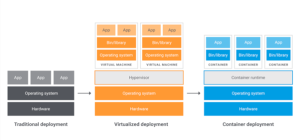
2 Containers vs. Virtual Machines
To understand containers, it’s helpful to compare them to virtual machines (VMs), another popular virtualization technology.
2.1 How Virtual Machines Work
Virtual machines emulate an entire computer system, including the operating system (OS), on a physical server. Each VM includes a full OS, application code, and dependencies, which makes it heavy in terms of storage and resource usage. VMs rely on a hypervisor (like VMware or Hyper-V) to manage multiple virtual machines on a single physical server. While VMs are powerful, they consume significant CPU, memory, and disk space because each VM runs its own OS.
2.2 How Containers Work
Containers, on the other hand, are much lighter. Instead of including a full OS, containers share the host operating system’s kernel and only package the application and its specific dependencies. This makes containers smaller (often megabytes instead of gigabytes) and faster to start than VMs. Containers use technologies like Docker to isolate applications, ensuring they don’t interfere with each other while sharing the host OS.
2.3 Key Differences
- Size and Speed: Containers are smaller and start in seconds, while VMs are larger and take minutes to boot.
- Resource Efficiency: Containers use fewer resources since they share the host OS, whereas VMs require a separate OS for each instance.
- Portability: Containers are highly portable across different environments, while VMs may require additional configuration.
- Use Case: VMs are ideal for running different OSes on the same hardware, while containers are better for deploying consistent applications across environments.
In short, containers offer a lightweight, efficient alternative to VMs for modern application deployment.
Learn more about Docker at Docker Official Site.
3 What are Microservices?
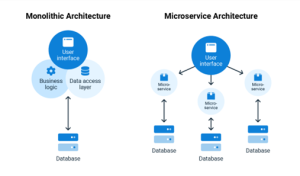
Microservices are an architectural approach where an application is broken into small, independent services that communicate over a network. Each microservice focuses on a specific function, for example, user authentication, payment processing, or inventory management and can be developed, deployed, and scaled independently.
Unlike traditional monolithic applications, where all components are tightly coupled, microservices allow teams to work on different parts of an application simultaneously. This modularity improves flexibility, speeds up development, and makes it easier to update or replace individual components without affecting the entire system.
Containers and microservices go hand in hand. Containers provide the perfect environment for running microservices because they are lightweight, portable, and easy to scale. By packaging each microservice in its own container, developers can deploy and manage them independently.
4 Container Orchestration
As applications grow, managing hundreds or thousands of containers manually becomes impractical. This is where container orchestration tools come in. Orchestration tools automate tasks like deploying, scaling, load balancing, and recovering containers.
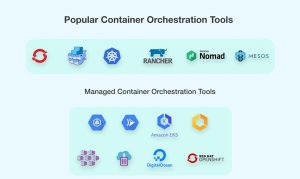
4.1 Popular Orchestration Tools
- Kubernetes: The most widely used orchestration platform, Kubernetes (often called K8s) manages containers across a cluster of servers. It handles tasks like scaling containers based on demand, distributing traffic, and ensuring high availability.
- Docker Swarm: A simpler alternative to Kubernetes, Docker Swarm is built into Docker and is suitable for smaller-scale deployments.
- Apache Mesos: A flexible platform for managing large-scale containerized and noncontainerized workloads. Learn more about Apache Meson.
4.2 Kubernetes in Focus
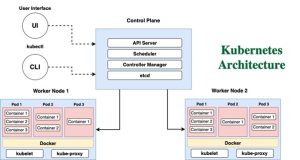
Kubernetes is the go-to choice for many organizations due to its robust features. It organizes containers into pods, which are groups of one or more containers that share resources and work together. Kubernetes automates
- Scaling: Automatically adds or removes containers based on traffic or resource needs.
- Load Balancing: Distributes incoming traffic across containers to ensure no single container is overwhelmed.
- Fault Tolerance: Restarts or replaces failed containers to maintain application availability.
- Service Discovery: Allows containers to find and communicate with each other seamlessly.
Kubernetes can be deployed on both private and public clouds, making it versatile for different environments.
5 Containers in Private and Public Clouds
Containers can run in various environments, including private clouds (on-premises infrastructure) and public clouds (services like AWS, Azure, or Google Cloud). Each has its advantages and use cases.
5.1 Private Cloud Containers
A private cloud is a dedicated infrastructure managed by an organization. Running containers in a private cloud offers
- Control: Organizations have full control over security, compliance, and resource allocation.
- Security: Sensitive data stays within the organization’s infrastructure.
- Customization: Companies can tailor the environment to their specific needs.
However, private clouds require significant upfront investment in hardware and maintenance. Kubernetes is often used to manage containers in private clouds, with tools like Red Hat OpenShift or VMware Tanzu simplifying deployment.
5.2 Public Cloud Containers
Public clouds provide container services through platforms like Amazon ECS, Azure Kubernetes Service (AKS), or Google Kubernetes Engine (GKE). Benefits include
- Scalability: Public clouds offer virtually unlimited resources to scale containers.
- Cost Efficiency: Pay-as-you-go pricing reduces upfront costs.
- Managed Services: Cloud providers handle infrastructure maintenance, allowing teams to focus on development.
The trade-off is less control over the underlying infrastructure and potential concerns about data privacy. Kubernetes is widely supported in public clouds, with managed services reducing the complexity of cluster management.
6 Why Containers and Microservices Matter
The combination of containers and microservices is transforming how applications are built and deployed. Containers provide the portability and efficiency needed to run microservices at scale, while orchestration tools like Kubernetes ensure reliability and automation. Together, they enable:
- Faster Development: Teams can work on individual microservices independently.
- Scalability: Applications can handle increased traffic by adding more containers.
- Resilience: Orchestration tools automatically recover from failures.
- Cost Savings: Containers use resources efficiently, reducing infrastructure costs.
7 Conclusion
Containerization for modern application deployment empowers organizations to build scalable, resilient, and efficient systems. Containers streamline development by ensuring consistency, while microservices enhance flexibility. With orchestration platforms like Kubernetes, both private and public cloud deployments become more manageable, allowing businesses to stay agile in an evolving digital landscape.
 +94 112 375 656
 info@apts.lk
 422/3,Galle Road, Colombo 3, Sri Lanka