
Blog
The New Frontier of Cyber Threats: Defending Against AI-Powered Attacks
Remember when phishing emails were easy to spot? Poor grammar, generic greetings, and
suspicious links? That era is rapidly closing. Today’s most sophisticated cyber threats aren’t just
using technology, they’re learning from it. Welcome to the age of AI-powered cyber-attacks,
where the adversary is automated, adaptive, and alarmingly efficient.
The Rise of the AI-Powered Adversary
AI is a dual use tool. While we leverage it for threat detection and security automation,
malicious actors are weaponizing it to create more potent, scalable, and evasive attacks. This
isn’t science fiction it’s today’s reality. The barrier to entry is lowering, enabling even less skilled
threat actors to launch high impact campaigns.
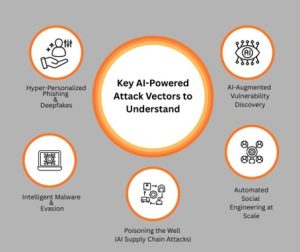
Key AI-Powered Attack Vectors to Understand:
- Hyper-Personalized Phishing & Deepfakes: Forget “Dear Customer.” AI analyzes your
public data (LinkedIn, social media) to craft eerily accurate emails, texts, or even voice
clones (vishing) of your CEO or a colleague. Deepfake video calls are the next logical,
terrifying step for Business Email Compromise (BEC) and financial fraud. - AI-Augmented Vulnerability Discovery: Attackers use AI to automatically scan code,
networks, and applications, identifying weaknesses at a speed and scale humans can’t
match. This drastically shortens the “time-to-exploit” for newly discovered
vulnerabilities. - Intelligent Malware & Evasion: Malware can now use AI to learn its environment, detect
sandboxing (security analysis environments), lie dormant until it’s safe, and morph its
behavior to avoid signature-based detection. - Automated Social Engineering at Scale: AI chatbots can conduct convincing,
personalized conversations with thousands of targets simultaneously, building trust and
extracting credentials or sensitive information without human intervention. - Poisoning the Well (AI Supply Chain Attacks): The most insidious method involves
corrupting the data used to train AI models themselves. By injecting biased or malicious
data, attackers can cause downstream AI security systems to fail or make incorrect
decisions.
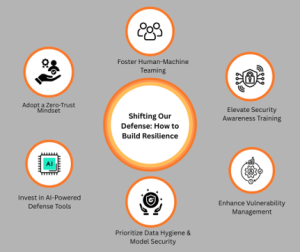
Shifting Our Defense: How to Build Resilience
The old playbook isn’t enough. We must fight AI with AI and reinforce our human firewall.
Here’s a strategic framework.
6. Adopt a Zero-Trust Mindset: The principle of “never trust, always verify” is paramount.
Implement strict access controls, micro- segmentation, and continuous authentication. Assume
breach and limit lateral movement.
7. Elevate Security Awareness Training: Train employees to be skeptical of
perfect communication. Teach them to verify unusual requests through secondary channels
(e.g., a quick phone call on a known number) and to recognize the potential for deep fakes.
Phishing simulations must now include AI-generated lures.
8. Invest in AI-Powered Defense Tools: Leverage your own AI and Machine Learning (ML)
for:
- Behavioral Analytics: Detect anomalies in user and entity behavior (UEBA) that might
indicate a compromised account, like unusual login times or data access patterns. - Email Security: Use AI that analyzes writing style, metadata, and communication
patterns to flag sophisticated impersonation attempts. - Endpoint Detection & Response (EDR): Deploy solutions that use ML to identify
malicious processes based on behavior, not just known signatures.
9. Prioritize Data Hygiene & Model Security: For organizations developing AI, secure your
training data pipelines. Monitor models for drift or unexpected behavior. Understand that your
AI model is critical infrastructure.
10. Enhance Vulnerability Management: Use AI-driven tools to prioritize patching based on
real-world exploit potential and your unique asset landscape. Speed is non-negotiable.
11. Foster Human-Machine Teaming: AI excels at processing vast data sets and identifying
patterns. Humans excel at strategic thinking, context, and ethical reasoning. The most effective
Security Operations Center (SOC) will combine both.
The AI revolution in cyber security is a permanent shift. It creates asymmetric advantages for attackers but also provides our greatest hope for defense. The organizations that will thrive are those that proactively adapt their strategies, invest in next-gen tools, and continuously cultivate a culture of security awareness.
Is your organization’s defense strategy being upgraded alongside the offensive capabilities of adversaries?
Email: info@apts.lk
Contact Us: 0112 375 656
Article Written By – Gayashan Perera (Senior Engineer- Cyber Security)
 +94 112 375 656
 info@apts.lk
 422/3,Galle Road, Colombo 3, Sri Lanka