
Blog
Why GRC Should Be Part of How Your Business Operates
Running a business today is not just about delivering products or services. Every organization has information to protect, employees to manage, systems to maintain, suppliers to monitor, and regulations to follow. As the business grows, managing all of these areas becomes more complicated.
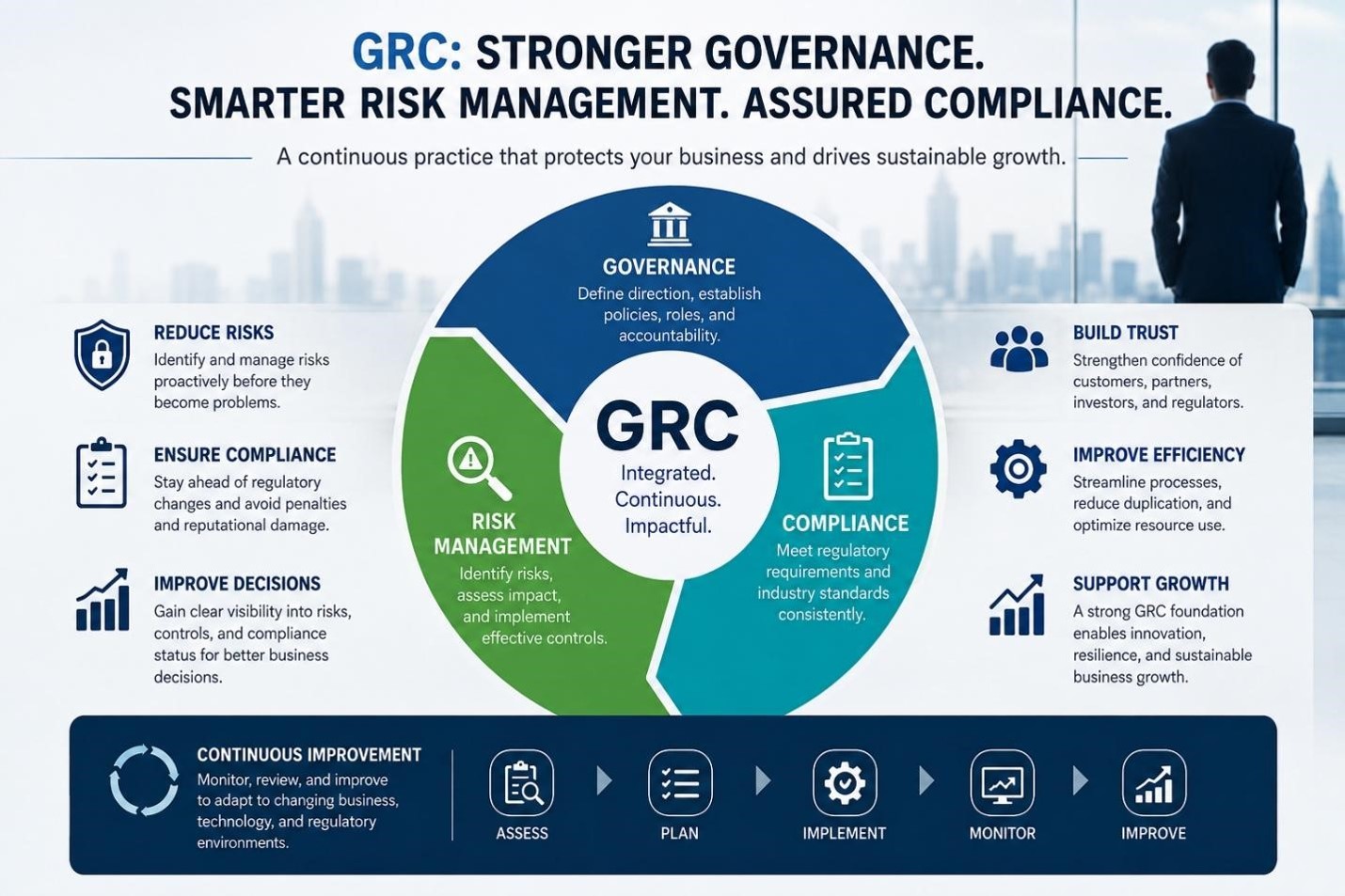
This is where Governance, Risk and Compliance (GRC) becomes important. However, GRC is often misunderstood. Some organizations see it as something they need only when an audit is coming up or when they want to obtain an ISO certification. Others treat it as a collection of policies and documents that need to be maintained. In reality, GRC should be part of the way a business operates every day.
What Happens When GRC Is Only an Audit Exercise?
We often see organizations prepare very well when an audit or customer assessment is approaching. Policies are updated, documents are collected, risks are reviewed, and corrective actions are completed.
But what happens after the audit?
Over time, access reviews may be missed, policies may become outdated, new employees may not receive the required awareness training, supplier risks may not be reviewed, and identified risks may remain open.
This creates a cycle where the organization is constantly reacting to requirements instead of managing them proactively. Having a policy is important, but having a process to make sure that the policy is actually followed is even more important.
For example, an organization may have an access control policy. But if nobody regularly reviews whether employees still have the right level of access, the policy alone does not reduce the risk.
This is where having an established GRC practice makes a difference.
GRC Helps Businesses Understand Their Risks
No organization can completely eliminate risk. The important thing is to understand what could go wrong and decide what needs to be done about it.
A proper GRC practice helps an organization identify its important risks, understand their potential impact, assign responsible owners, and track actions to reduce them.
A risk register, for example, should not simply be a spreadsheet prepared for an auditor. It should help management answer practical questions:
- What are our most important risks?
- Who is responsible for managing them?
- What controls do we currently have?
- Where are the gaps?
- What actions are still outstanding?
- Which risks require management attention?
When these questions are regularly discussed, risk management becomes part of business decision-making rather than just a compliance activity.
GRC Is More Than Compliance
Compliance is an important part of GRC, but it is not the whole picture.
Organizations may need to meet legal requirements, industry regulations, customer requirements, contractual obligations, and information security standards.
Keeping track of all these requirements can become difficult, particularly when the organization is growing.
A structured GRC practice helps connect these requirements with the organization’s actual processes and controls. Instead of rushing to understand requirements when an audit is announced, the organization can continuously monitor them and take action when something changes.
This also makes audits and customer assessments much easier because the organization is already maintaining the necessary processes and evidence.
Making GRC Part of Everyday Work
- The real value of GRC can be seen in everyday situations.
- When a new employee joins, their access should be based on their role.
- When an employee leaves, their access should be removed promptly.
- When a new supplier is selected, the security risks associated with that supplier should be
considered. - When sensitive information is collected, the organization should know how it needs to be
classified, stored, shared, and protected. - When an incident occurs, the organization should know who needs to respond and what
actions need to be taken.
These may seem like separate activities, but a good GRC practice brings them together through clearly defined processes, responsibilities, controls, and monitoring.
Why Businesses May Need GRC Expertise
Building a GRC practice internally can be challenging. Employees may already have their own responsibilities, while GRC requires knowledge of governance, risk management, information security, compliance, documentation, and continuous improvement.
This is where an experienced GRC service provider can add value.
A GRC partner can work with an organization to understand its current practices, identify gaps, develop appropriate policies and procedures, establish risk and compliance processes, define responsibilities, and help integrate these activities into normal business operations.
The goal should not be to create hundreds of documents just to satisfy an audit.
The goal is to build a GRC practice that employees understand, management can monitor, and the organization can continue to maintain.
From Compliance to Continuous Improvement
A mature GRC approach changes the mindset of an organization.
Instead of asking, “What do we need to do for the audit?”, organizations begin asking, “How can we manage our risks and improve the way we operate?”
That change is important.
GRC helps organizations identify problems earlier, make better decisions, strengthen accountability, protect important information, and respond more effectively to changes in the business environment.
Conclusion
GRC should not be something that appears on the organization’s agenda once a year.
It should be part of how the business operates.
When governance, risk management, and compliance become continuous practices, organizations are better prepared to deal with security threats, regulatory changes, operational challenges, and growing customer expectations.
You do not need to wait for an audit finding, security incident, or regulatory requirement to start managing these areas properly.
The best time to establish a GRC practice is before a problem forces you to.
With the right structure, processes, and support, GRC can move from being a compliance obligation to becoming a practical tool that helps your business operate with greater confidence, control, and resilience.
Contact Us: 0112 375 656
Email: info@apts.lk
Sathmi Gamage
Associate Cyber Security Engineer & GRC
 +94 112 375 656
 info@apts.lk
 422/3,Galle Road, Colombo 3, Sri Lanka